Arts and Sciences Summer Exploration Program
The Arts and Sciences Summer Exploration Program offers middle and high school students one-week intensive academic enrichment courses intended to introduce them to new areas of study or allow them to engage in content they may already have an interest in. In-person classes meet from 9:00 a.m. to 4:00 p.m. Monday through Friday, and are taught by Ohio State faculty, staff, and graduate students. Teaching is active, hands-on and encourages participants to engage with the instructional team and their fellow participants. These courses are not for grade or credit and are designed for self-motivated learners.
Eligibility is based on a participant’s grade level for the 2025-2026 school year. Students entering 7th - 9th grades in the fall of 2025 are eligible for middle school courses. Students entering 10th - 12th grade in the fall of 2025 are eligible for high school courses.
If you have questions about this program, please contact ExploreASC@osu.edu or call Andre Brown at 614-247-1618.
We are no longer accepting applications for the summer 2025 program. The application deadline was May 1st, 2025.
We invite you to sign up for updates to receive information about our programs and be alerted when the when future application windows open.
Looking for more options? Check out other summer youth programs offered by departments in the College of Arts and Sciences.
2026 Course Offerings for Middle School Students
Music & Mind Studio
Dates: June 1-5
Eligibility: Middle School (rising 7th - 9th graders)
Description: Music & Mind Studio is a hands-on pre-college course for middle and high school students. Through singing, focused listening, games, and mini experiments, students discover how tempo, dynamics, timbre, and lyrics shape emotion and attention, and build tools for focus, energy and calm. Each day blends warm-ups, small group music activities, and critical and reflective activities, with flexible roles for every comfort. No prior training required.
Eco-Printmaking: Sustainable Art for People and the Planet
Dates: June 1-5
Eligibility: Middle School (rising 7th - 9th graders)
Description:
In this hands-on course, students will explore eco-printmaking techniques and create original artwork using specialized printmaking equipment in the OSU Printmaking studio in the Department of Art. Traditional printmaking often involves toxic materials and methods that can be harmful to both health and the environment. This course introduces innovative printmaking techniques that prioritize the well-being of the artist and sustainability. Each day, students will learn eco-friendly approaches to various printmaking techniques, including screen-printing, relief printing, monoprinting, and risography.
Throughout the week, students will engage in lectures, demonstrations, and discussions with guest speakers, as well as have time for individual exploration. They will practice printmaking with a focus on sustainability, creativity, and the importance of art in environmental protection. At the end of the week, participants will have the opportunity to share and exchange their original prints in a class print exchange, culminating in a unique portfolio of eco-conscious artwork.
2026 Course Offerings for High School Students
The Earth Lab: Careers in Earth, Climate, and Ocean Sciences
Dates: June 1-5
Eligibility: High School (rising 10th - 12th graders)
Description: Ever wondered what earth scientists actually do? With nearly 27% of the current earth science workforce retiring by 2029 and a projected job growth faster than the national average, there's never been a better time to explore careers in this field. In addition to promising job growth, earth scientists earn competitive salaries, with a median annual wage of $92,580 in 2023. This course takes students beyond textbooks to explore real-world careers that shape our planet's future while offering excellent employment prospects and career stability. Each day of this course focuses on a different in-demand earth science career, combining hands-on activities, guest speakers from each profession, and practical applications to demonstrate to students how they can turn a passion for earth science into a meaningful career. Students will analyze samples and collect data using industry-standard techniques and equipment and visit campus facilities like the Orton Geological Museum and the Byrd Polar and Climate Research Center. Through lab activities, field experiences, and problem-solving challenges, students will learn how earth scientists work to ensure clean water and sustainable resources for future generations. This course is for rising high school sophomores through seniors interested in exploring STEM careers, preparing for college, and solving real-world problems. The world needs more people who understand our planet, and this program helps students explore how to become one of them.
Food Chemistry: Chemistry you can eat
Dates: June 1-5
Eligibility: High School (rising 10th - 12th graders)
Description: This hands-on course reveals that cooking is chemistry, and that kitchen is a laboratory! In this course we will answer questions about Why does bread rise? Why does steak brown and toast taste so good? Why do oil and water finally mix in mayonnaise? Inspired by Harold McGee's book: On Food and Cooking, we'll spend five days exploring the science behind everything we eat. Our focus would be on the big four molecules: water, carbohydrates, proteins, and fats in our food. We will talk about the chemical reactions involved in cooking them and why they become delicious.
“They’ll Tell You I’m Insane”: Taylor Swift and the “Mad Woman
Dates: June 8-12
Eligibility: High School (rising 10th - 12th graders)
Description: In this course, we will explore how Taylor Swift interacts with the cultural stereotype of the “mad woman” throughout her discography and other media. Together, we will develop a timeline of when, how, and why Taylor Swift represents herself (or is represented) as a “mad woman.” We will also consider how larger concepts of anger, gender, disability, and relationship roles impact who is viewed as “crazy.” Ultimately, we will ask: Is Taylor Swift crazy? Are we crazy? And is being “crazy” really such a bad thing?
This course will feel similar to an English class, but we will also draw on creative writing, cultural studies, disability studies, and psychology. Students will be expected to participate in group activities and discussions. And, yes, we will listen to a lot of Taylor Swift along the way.
Breaking the Rules: Cross-Genre Creative Writing
Dates: June 8-12
Eligibility: High School (rising 10th - 12th graders)
Description:In this hands-on creative writing course, we’ll explore what happens when we bend the “rules” of genre. Together, we’ll experiment with fiction, poetry, and creative nonfiction—mixing, remixing, and inventing new forms. What if a poem were a Tumblr poll? What if a flash story took the shape of a job application? What if a personal essay unfolded as a series of Google searches? Through playful experimentation and collaborative curiosity, you’ll create original cross-genre and multimedia pieces. We’ll wrap up the session by producing a class zine that celebrates your most imaginative, boundary-breaking work.
Leadership: What It Is and How to Get It
Dates: June 8-12
Eligibility: High School (rising 10th - 12th graders)
Description: Leadership is a term that people are comfortable tossing about, yet when pressed, cannot define. It is a trait that we are increasingly expected to have, yet it seems elusive, perhaps only reserved for the most charismatic and business minded. This course will introduce leadership as a discipline, as a practice, and as a career. Importantly, we will debunk various stereotypes surrounding what makes for good and bad leaders (spoiler alert: charisma isn’t required). You will learn that there are a diversity of theories and styles of leadership and be introduced to historical leaders, both good and bad. You will work to discern your own values and leadership styles and begin to cultivate various skills in leadership. Along the way, you will also see leadership in action, hearing from leaders in a number of different fields. There are many pathways to leadership, as we will learn. At the end of the course, you will have the building blocks to start to forge yours.
Creative Coding
Dates: June 8-12
Eligibility: High School (rising 10th - 12th graders)
Description: Discover how computer programming can be a powerful tool for artistic expression. In this hands-on studio art course, students will explore the intersection of art and code. Using p5.js, a beginnerfriendly JavaScript library created by artists for artists, students will learn to generate dynamic visuals and simple animations through algorithms. To complement their coding practice, students will also use Inkscape, a vector graphics drawing program, allowing them to blend traditional digital drawing techniques with generative code-based art. Students will learn coding syntax and structure through hands-on creation of their own artwork. Each new concept will be introduced through guided experimentation, allowing students to immediately apply their skills in personal projects. The week culminates in a final animation that blends drawing and programming, showcased as a large-scale projection. No prior experience in coding or art is required. All digital tools used are free and open source, enabling students to continue exploring long after the course ends.
What’s in the Water? A Week of Chemical Discovery and Problem Solving
Dates: June 8-12
Eligibility: High School (rising 10th - 12th graders)
Description: What happens when a local river turns suspiciously colorful? In this week-long hands-on program, students become environmental chemists working to solve the mystery of a contaminated water sample. Throughout the week, participants will explore how chemists test and identify unknown substances. They’ll use precipitation reactions to find metal ions, paper chromatography to separate dyes, and pH testing to study acidity. Later in the week, students will use visible spectroscopy to compare the colors and light absorption patterns of known and unknown dyes. Each lab builds new skills and connects directly to the final challenge — analyzing a simulated “river sample” to uncover what’s polluting the water. The week ends with students presenting their findings and explaining how they reached their conclusions. By the end of the program, students will have learned real laboratory techniques, used authentic chemistry equipment, and discovered how chemistry helps protect our environment.
Introduction to the Darkroom
Dates: June 22-26
Eligibility: High School (rising 10th - 12th graders)
Description:This course is an introductory exploration of analog photographic processes and the foundations of silver gelatin printing in the darkroom. Students will learn to use manual cameras to properly expose their film, process their own film, make cameraless images in the darkroom (photograms and cyanotypes), and print their own black and white images. In addition, they will learn valuable photographic skills that can be applied to digital imaging, an overview of historical and contemporary photographers, and information about sharing and exhibiting artwork. This course will be hands-on, allowing students to explore something both technical and creative.
Poetic Discovery
Dates: June 22-26
Eligibility: High School (rising 10th - 12th graders)
Description:
“To be a writer does not mean to preach a truth, it means to discover a truth.”
— Milan Kundera
This course will center on the discovery of truth through poetry. The focus will be on generative writing with an emphasis on reading as an important fundament to meaningful writing. The prompts, lessons, and activities in this course will encourage students to look both inward and around them using language. We will familiarize ourselves with basic poetic terminology that will allow us to better analyze poems, and then employ those elements in our own writing. This will be a pencil-and-paper course (with the occasional scissors and glue) to create a space free from the usual distractions of technology and allow students to focus on their writing and reading. At the end of the week, students will receive an anthology with a piece written by each of them so they can show off the work they created together in this course. This course welcomes students with any level of experience in poetry, whether you want a space to work on writing you have been developing for years or you’re just coming in with a spark of curiosity about what poetry can offer you. The goal is to figure out how to use your voice in a way that feels true to you, and to discover something about the world or yourself through that exploration.
Introduction to Arts & Entertainment Management
Dates: June 22-26
Eligibility: High School (rising 10th - 12th graders)
Description:
This course introduces high school students to key concepts in managing arts and entertainment enterprises across all sectors. This course will cover topics such as arts and entertainment management best practices, common leadership styles, marketing the arts, arts and entertainment management career preparation and trajectories, what constitutes an entrepreneurial mindset, and arts ecosystems. Students will learn about the practical application of these concepts through brief lectures, group activities, independent reflections, and by participating in discussions led by industry professionals. Student learning culminates in presenting small group projects, which visualize the interconnectedness of arts and entertainment enterprises throughout Ohio.
Application and deadline
If a participant requires an accommodation such as interpretation to participate in this program, please contact the program at ExploreASC@osu.edu or 614-292-8208. Requests should be made as soon as possible. Requests made two weeks before the first day of a course will generally allow us to provide seamless access, but the university will make every effort to meet requests made after this date.
We invite you to sign up for updates to receive information about our programs and be alerted when the when future application windows open.
Tips for submitting an application
- When you click on the Apply Now button, you will be taken to the application system.
- If this is the first time you are applying to our program, you will need to register to create a free account. This option is available on the bottom left of the log in box.
- Once registered, you can login and submit your application.
- Please note that applications should be completed by a parent/legal guardian.
- You will receive an email confirming that your application has been submitted.
- You can submit multiple applications from the same account. After submitting the first application, click on the home icon in the upper right corner.
- All applications you have submitted will be visible from the home screen. To submit an additional application, click the carrot next to Options on the upper right corner of application text box. Select Apply Again from the dropdown menu.
Costs and aid
The program fee for the Arts and Sciences Summer Exploration 2026 program is $550 per one-week course, which includes all course materials and activities, lunch, and snacks.
- Sibling discount: A 10% discount on the program fee will be applied to the registration of the second + child from the same household.
- Limited need-based financial assistance may be available in the form of partial support. Financial assistance can be requested on the program application.
Payment deadlines
Applicants have one week to accept their offer of admission to the program and pay the program fee. All payments must be made through the applicant portal. Once an offer is accepted and payment made, the parent or legal guardian must submit emergency contact and medical information, as well as signed Policy Acknowledgement and Consent forms no later than May 15, 2026.
Refund Policy
The Arts and Sciences Summer Exploration Program recognizes that sometimes plans change. Participants may request a refund of the program fee by emailing ExploreASC@osu.edu according to the following schedule:
- On or before May 1, 2025: 100% of program fee paid
- May 2 – May 15, 2025: 50% of program fee paid
- On or after May 16, 2025: No refund of program fee paid
Program Details
While plans for each course may differ slightly, the daily schedule follows this general model:
- Drop off 8:15 - 8:45 a.m.
- Morning session 9:00 - 11:30 a.m.
- Travel to lunch 11:30 - 11:45 a.m.
- Lunch at Traditions 11:45 - 12:45 p.m.
- Travel time 12:30 - 12:45 p.m.
- On campus activity 12:45 – 1:45 p.m.
- Afternoon session 2:00-3:45 p.m.
- Travel to pick-up location 3:45 - 4 p.m.
- Pick up 4:00 - 4:30 p.m.
Participants will always be escorted between pick-up/drop-off, their assigned classroom, the dining hall, and the on-campus activity by program staff. Additional information about the program will be emailed to participants and families, as needed, closer to the start of the program.
Lunch will be provided daily at the Traditions at Scott dining hall and will be supervised by program staff. Traditions provides a wide variety of food options that meet the most common dietary needs and restrictions, including halal, gluten-free and vegetarian. However, kosher dining is not supported during summer term.
The pick-up and drop-off location for students is the corner of Annie and John Glenn Avenue and Millikin Road, outside of the PAES building (see maps below). Please drop your child off from the eastbound lane of Annie and John Glenn Avenue. The drop-off/pick-up location will be marked with a sign and program staff will be present to check your child in and out of the program.
If you are using a navigation system for directions, enter the following address: 305 Annie and John Glenn Avenue, Columbus, Ohio, 43210.
Please do not park in the drop-off/pick-up lane. If you need to park, or your child is driving themselves to and from the program, the closest surface lot parking is at the Ohio Stadium. The closest garage parking is Tuttle Garage. You can learn more about parking at Ohio State, including hourly rates, on the CampusParc website.
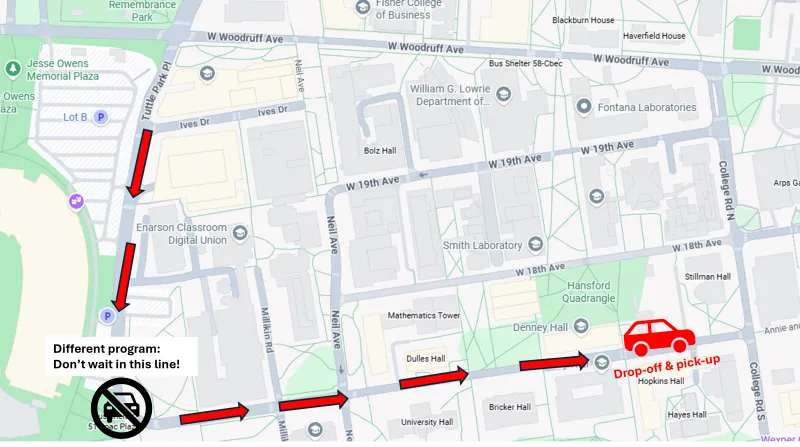
The image above shows the ideal route to the drop off and pick up location. The image below shows the drop off and pick up lane from the street view.
For those riding COTA, the closest bus stop to the drop-off/pick-up location is N. High Street & E. 15th Avenue. See the COTA website for more information.
The first day of the program will kick-off with a brief orientation session. At 8:45 a.m. program staff will walk the students to the orientation location. At the orientation, students will receive a program t-shirt and lanyard, the program staff will be introduced, and the daily schedule will be reviewed. After orientation, students will be escorted to their classrooms and the morning session will begin.
What to Wear
Participants should wear comfortable clothing appropriate for the classroom, as well as for a range of temperatures. For most courses, participants will spend most of the day inside air-conditioned classrooms. However, we will be walking between the drop-off/pick-up location, classrooms, campus locations and the dining hall. Dressing in layers and wearing comfortable walking shoes is recommended. Any course specific requirements are listed in the course description.
Friday What to Wear
Each Friday on the last day of classes, we will take pictures of each class cohort. We encourage participants to wear their Arts & Sciences Summer Exploration t-shirt on Friday for this event!
Daily Packing List
- Cell phone and charger (optional)
- Personal academic supplies, such as pens/pencils, notebook, and backpack.
- Any special academic materials needed for courses beyond this basic list will be provided by the program.
- Snacks and water: Participants should bring a refillable water bottle every day. While the program will provide an afternoon snack, participants are allowed to bring their own snacks. However, we request that, for the safety of participants with nut allergies, no snacks containing nuts be brought to the program.
- Personal medications in their original labeled containers (if taken during the day)
- Sunscreen and umbrella or rain jacket (optional)
Shortly after an applicant accepts their offer of admission, the parent or legal guardian will receive an email from DocuSign with links to program policy and consent forms. These forms must be reviewed and signed by May 1, 2025.