From the Desk of Dean David Horn
Artificial intelligence is disrupting the ways we produce knowledge, create art, interact with others and the world around us and understand ourselves. In this time of profound change, institutions are called not simply to adapt or react, but to lead with vision. Drawing on the power of the arts, humanities, social sciences and the natural and mathematical sciences, the College of Arts and Sciences is shaping the future of AI, and of the world it brings into being.
I’m proud of the work our faculty and students are undertaking in laboratories, studios, classrooms and spaces beyond our campus: to develop, responsibly use and critically evaluate AI tools; to appreciate the power and limits of AI systems; and to map and help guide the social transformations these are producing.
The BuckAI Observatory is building the computing capacity that can accelerate work in research areas such as remote sensing, while astronomy professor Yuan-Sen Ting uses AI to study galactic archaeology and stellar evolution. Political science professor Ryan Kennedy enriches our understanding of public opinion through AI-powered surveys. And a new interdisciplinary certificate in AI, Ethics and Society prepares students to ask and answer urgent questions about emergent technologies. From the cosmos to the individual and everywhere in between, the College of Arts and Sciences is exploring the world of AI.
- David Horn, Dean of the College of Arts and Sciences
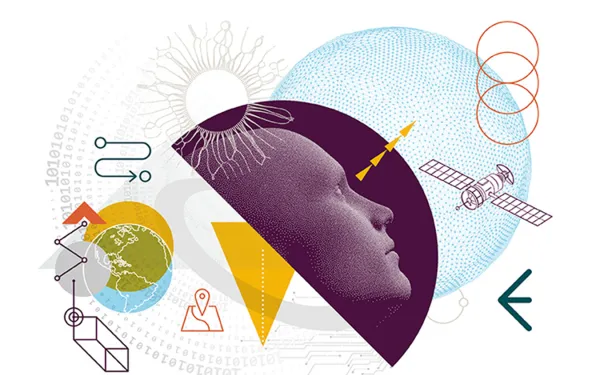
Advancing AI research in Earth and space sciences
The College of Arts and Sciences has launched BuckAI Observatory, a new center of excellence dedicated to applied AI for earth and planetary observation. Led by Joachim Moortgat, a professor in the School of Earth Sciences, BuckAI Observatory advances Ohio State’s leadership in artificial intelligence by integrating cutting-edge AI algorithms with remote-sensing science and other data-rich domains. The center’s mission includes driving research excellence, providing shared cyberinfrastructure and expertise, cultivating interdisciplinary collaboration, educating the next generation of researchers and engaging the broader community through outreach and policy involvement.
Blending astronomy and AI
Yuan-Sen Ting, an associate professor at Ohio State, blends astronomy with cutting-edge AI to uncover the secrets of the universe. He uses AI as a tool to analyze massive astronomical datasets, accelerating scientific discovery. A former NASA Hubble Fellow and Harvard PhD, Ting has published in Nature and Nature Astronomy and shares his passion through TEDx talks, podcasts and columns in Malaysia, where he explores topics from AI to the cosmos in ways everyone can enjoy.
Advancing AI research in Earth and space sciences
The College of Arts and Sciences has launched BuckAI Observatory, a new center of excellence dedicated to applied AI for earth and planetary observation. Led by Joachim Moortgat, a professor in the School of Earth Sciences, BuckAI Observatory advances Ohio State’s leadership in artificial intelligence by integrating cutting-edge AI algorithms with remote-sensing science and other data-rich domains. The center’s mission includes driving research excellence, providing shared cyberinfrastructure and expertise, cultivating interdisciplinary collaboration, educating the next generation of researchers and engaging the broader community through outreach and policy involvement.
Blending astronomy and AI
Yuan-Sen Ting, an associate professor at Ohio State, blends astronomy with cutting-edge AI to uncover the secrets of the universe. He uses AI as a tool to analyze massive astronomical datasets, accelerating scientific discovery. A former NASA Hubble Fellow and Harvard PhD, Ting has published in Nature and Nature Astronomy and shares his passion through TEDx talks, podcasts and columns in Malaysia, where he explores topics from AI to the cosmos in ways everyone can enjoy.

The AI lens on politics
Timashev Chair of Data Analytics and Professor of Political Science Ryan Kennedy studies how Americans think about political violence, using AI-powered surveys to go beyond simple answers and understand why people respond the way they do. His research shows that many apparent endorsements of violence actually stem from confusion or misinterpretation of survey questions. By analyzing participants’ explanations with AI, the studies reveal that true support for violent action is far lower than it appears, offering new insights into public opinion and survey design.

Arts and Humanities AI Institute: where the liberal arts lead the AI revolution
The College of Arts and Sciences created the Arts and Humanities AI Institute (AHAII), a pioneering center for humanistic scholarship and pedagogy, creative exploration and public engagement at the intersection of AI and the human experience. Directed by Chris Coleman, AHAII will be a community hub where faculty and students can engage around questions central to AI humanity; develop innovative curricula within the AI Fluency Initiative; collaborate in and beyond the arts and humanities on important topics such as ethics, bias, creativity, rediscovering history and art and technology; and use and critique AI tools to understand how they interact with arts and culture.
The AI lens on politics
Timashev Chair of Data Analytics and Professor of Political Science Ryan Kennedy studies how Americans think about political violence, using AI-powered surveys to go beyond simple answers and understand why people respond the way they do. His research shows that many apparent endorsements of violence actually stem from confusion or misinterpretation of survey questions. By analyzing participants’ explanations with AI, the studies reveal that true support for violent action is far lower than it appears, offering new insights into public opinion and survey design.
Arts and Humanities AI Institute: where the liberal arts lead the AI revolution
The College of Arts and Sciences created the Arts and Humanities AI Institute (AHAII), a pioneering center for humanistic scholarship and pedagogy, creative exploration and public engagement at the intersection of AI and the human experience. Directed by Chris Coleman, AHAII will be a community hub where faculty and students can engage around questions central to AI humanity; develop innovative curricula within the AI Fluency Initiative; collaborate in and beyond the arts and humanities on important topics such as ethics, bias, creativity, rediscovering history and art and technology; and use and critique AI tools to understand how they interact with arts and culture.