
From solving crimes and chasing storms to studying abroad in paths forged by Charles Darwin and Marie Curie, professors in the College of Arts and Sciences are bringing scientific textbooks to life for students at Ohio State.
“There’s been significant research in pedagogy over the last two decades to support the notion that students learn best through experiential learning,” said Associate Professor Jana Houser, also the Director of Undergraduate Studies in the Department of Geography. “That’s when they can get hands on, when they’re practicing what it is they’re studying.”
Classroom instruction continues to play a foundational role in courses, but professors within the college are taking that next step, finding ways to utilize that material and display real-world applications in the field.
“I feel there’s a lot more to education than just sitting in the classroom, just learning facts,” said Associate Professor Amanda Bird in the Department of Molecular Genetics. “A great way to learn is to actually get out into the community and do some hands-on learning.”
“I do love to teach in a classroom, that’s really fun, but it’s that extra added component. I think students learn a lot more about themselves and gain such a different set of skills than you would in a normal classroom.”
CSI: Ohio State
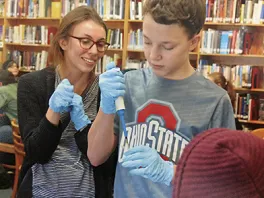
Perhaps the most unorthodox set of skills comes from Bird’s DNA Fingerprinting class, a service-learning course where undergraduates — through the lens of picking apart a crime scene — teach molecular biology techniques to students in Columbus City Schools.
“The undergraduates help the high school students to become essentially forensic experts by helping them to solve a crime scene with DNA evidence,” Bird said. “So, it’s not only a class where you get science, but at the same time, it’s both service and mentorship.”
The mock crime is the same for each class that Bird and her students visit: a high school science project has blown up and there are four potential suspects, all of whom left DNA at the crime scene. Undergraduates get a crash course in DNA, learning methods such as gel electrophoresis, a laboratory technique that separates and analyzes DNA and RNA fragments. They then teach these techniques to students, using it to ultimately solve the crime with classes that range anywhere from 10 to 70 high schoolers.
But beyond teaching molecular biology, undergraduates also have the chance to impart knowledge to students, getting them excited about science and educating them about the opportunities that exist in higher education.
“We’re hoping to just show that college is accessible to everybody,” Bird said. “We’re teaching the high school students about opportunities, scholarships, fellowships they could apply for to make college accessible. The undergraduates themselves, they’re doing service, but for me, the other big thing they’re learning is mentorship.”
Into the storm
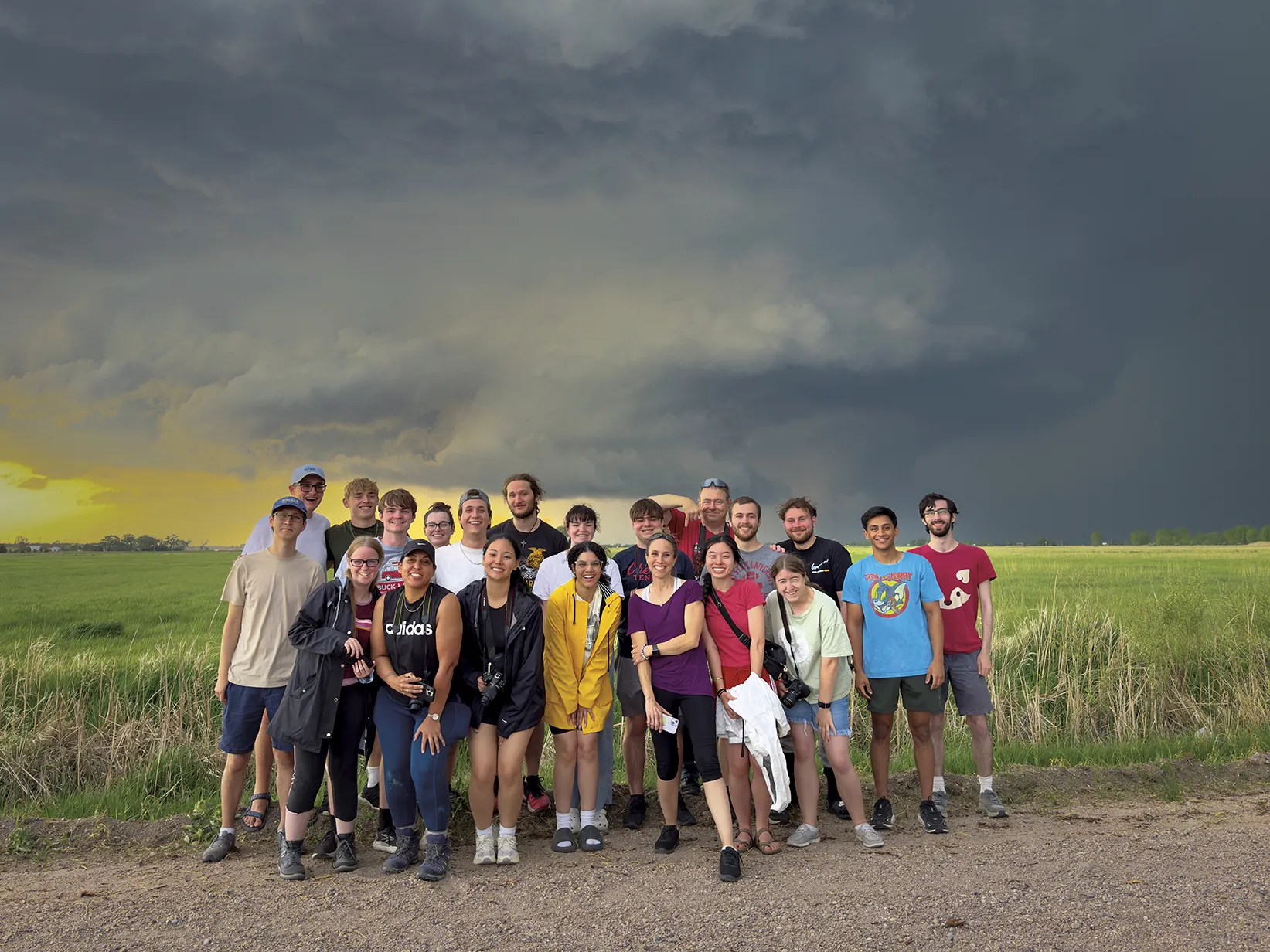
There’s no concern when solving a fabricated crime, but the same cannot be said when you hit the Central Plains from Texas all the way to Nebraska for Houser’s storm-chasing class, titled Field Observations of Severe Convective Storms.
Houser — who worked on the 2024 blockbuster film “Twisters” as a field coordinator for the filming of real storms — has led similar classes at Ohio University, and said the inception for the class is to give students a lived experience, taking in-class material and translating it to the real world.
“They get to experience the feelings of warm air being sucked into a storm and cold air being blown out behind it and visually seeing, in a 360-degree sense, the complete surroundings that exist around a storm,” she said. “It is much different and more impactful and longer lived than just learning something in a classroom.”
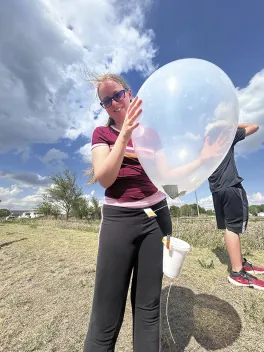
In this summer course, students — all of whom have a background in meteorology given the prerequisites for the class — join Houser for nine days of chasing storms in May, with 2025’s travels taking the group as far west as Wyoming in addition to storm chasing in hotbeds such as Kansas, Missouri, Nebraska, Oklahoma and Texas.
Each day begins with a morning weather briefing — usually led by Houser but occasionally by students — before everyone loads up into 12-passenger vans and sets out for a target location that has the best atmospheric conditions for producing an observable storm.
“If we feel confident in that location then we just sit and wait for the atmosphere to evolve and to figure out what our next move is,” said Houser, who added these days can include up to 14 hours of driving. From there, the class will track the storm down and try to get close enough to observe, identifying storm and cloud structure.
“The students learn very quickly the challenges and the nuances that are associated with storm chasing in a way that they don’t understand unless we actually get out and experience it and do it,” Houser said.
While it may not be as glamorous or dramatic as the movies — a good thing, given that maintaining student safety is the top priority for Houser — through this experience, students gain a new perspective and appreciation for weather forecasting.
“The students are absolutely amazed by what they see, and I love to feel their excitement as they’re seeing storms in a new capacity,” she said. “I’ve had multiple students say things like, ‘This was the opportunity of a lifetime.’ … This is an incredibly impactful experience for them, and to hear their excitement as they’re looking at storms in a new way and in a fully immersive way for the first time is just very rewarding to me.”
Science overseas
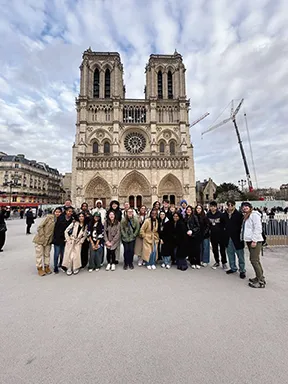
If storm chasing or crime solving isn’t quite someone’s speed, a trip through scientific history while studying abroad may be the right opportunity. Another course taking students out of the classroom, Bird leads Scientific Roots in Europe, where students learn about key scientific figures in the United Kingdom.
Students spend most of the semester learning about these scientists such as Darwin and Curie, with experts coming into class to help build a knowledge base of these pioneers and their discoveries. It culminates in a 10-day study abroad trip over spring break where students travel to Cambridge, London, Oxford and Paris, visiting historical sites where scientists previously walked the hallowed grounds.
“You actually get to see where [Darwin] wrote a lot of the books he’s famous for such as On the Origin of Species,” Bird said. “You get to walk on the path where he would walk every single day. There’s some very cool aspects of not only science, what you’ve learned in class, but you actually get to go and experience some of the places where these discoveries were made and where these scientists actually grew up.”
Beyond connecting class material to its physical roots, students — many of whom may be traveling abroad for the first time — are afforded the opportunity for their own growth, with the chance to experience different cultures with their peers.
“I think you do get to appreciate the human side of science, but it’s more as well,” Bird said. “There’s plenty of opportunity for experiencing personal growth … You learn so much more than just reading about a place in a book.”
Opportunities abound
These classes are just a brief offering, however, of the unique science courses offered by the College of Arts and Sciences. These lived experiences help students not only make a stronger connection to course material but better understand the opportunities available to them in higher education and beyond.
“Students have gained a much deeper appreciation for the challenges that professionals face,” Houser said. “They have gained insights into their own professional development and their own career choices as well.”
Photos: Jana Houser, Amanda Bird