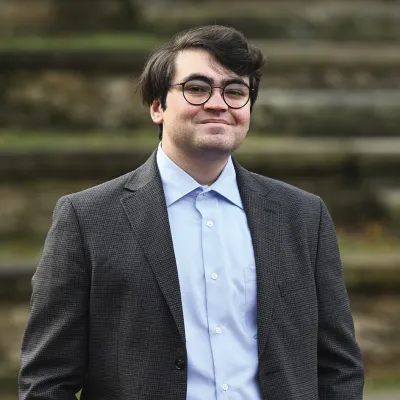
Chandler L’Hommedieu
Research Interests: Political Psychology, Behaviors, Attitudes, Public Opinion, Mass-Media
Education: BA, Political Science; BA, History, The University of Florida
What inspired your research?
My research was largely inspired by what I view as open questions in the field. While we know that political elites influence how the public perceives issues, we still lack a deep understanding of how those perceptions are transmitted and transformed. I wanted to explore this process more closely, especially given how contemporary politics is marked by increasingly polarized, evocative and populist rhetoric.
What first sparked your interest in political science, and what continues to draw you to the field?
I’ve always been fascinated by human behavior and the tools we use to study it. Political science offers a powerful framework for understanding how people make sense of a complex world. What keeps me drawn to the field is how dynamic it is — the political landscape is constantly shifting, which means there are always new questions to ask and new methods to apply.
What advice would you give to undergraduates who are considering pursuing a graduate degree?
I would encourage students to think of graduate school — and a PhD in particular — not only as a path toward academia but also as an opportunity for broad skill-building and intellectual growth. Graduate training teaches you how to design and conduct research, and that skill translates across countless domains. It’s a challenging but deeply rewarding experience for anyone who enjoys discovery and critical inquiry.
How do you hope to use your degree and research in the future?
I hope to continue working as a professional academic, but my ultimate goal is to build a career centered on research, regardless of where it takes place.
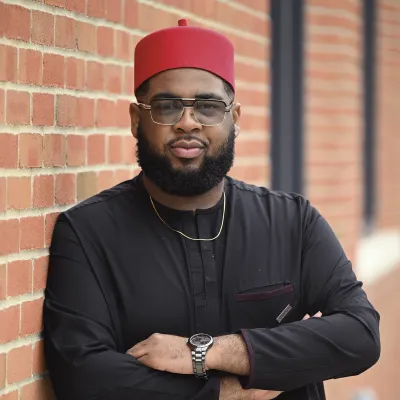
Ra'Phael Davis
Research Interests: International Relations, Comparative Politics
Education: BA, Philosophy; BA, International Studies, University of Arkansas at Little Rock; MA, Political Science, The Ohio State University
What inspired your research?
My peacebuilding research began years ago on the hard tiles of a Barcelona metro, where I was stopped and interrogated by police. I witnessed people being aggressively detained and left scarred, an experience I will never forget. The shock settled upon realizing they were refugees fleeing conflicts in West Africa. This moment exposed a shared, diasporic vulnerability that I carry with me daily. As both a scholar and practitioner, my life and work are dedicated to remembering those on that wall whose passports afforded them no such privilege, and to striving to understand and help address the ongoing conflicts in African countries.
What first sparked your interest in political science, and what continues to draw you to the field?
My interest was first sparked as an undergraduate in a course on Peacebuilding and Post-Conflict Reconstruction. I didn’t know what political science was then, but the course led to my selection for the National Science Foundation-sponsored Conflict Management and Peace Research program. Through that experience I received rigorous training in conflict analysis from inception through data communication.
What advice would you give to undergraduates who are considering pursuing a graduate degree?
My advice is to recognize the true malleability of a political science degree. I encourage anyone with deep interest in a topic to challenge themselves and pursue it; a graduate degree, combined with intentional networking and unwavering self-discipline, serves as a powerful conduit to access the professional and academic rooms they aspire to enter.
How do you hope to use your degree and research in the future?
I intend to remain in academia, continuing to teach and conducting cutting-edge research, as the classroom remains my first love. I am also considering Foreign Service or industry options where I can directly apply my research skills to roles that ameliorate human security and keep communities safe worldwide.