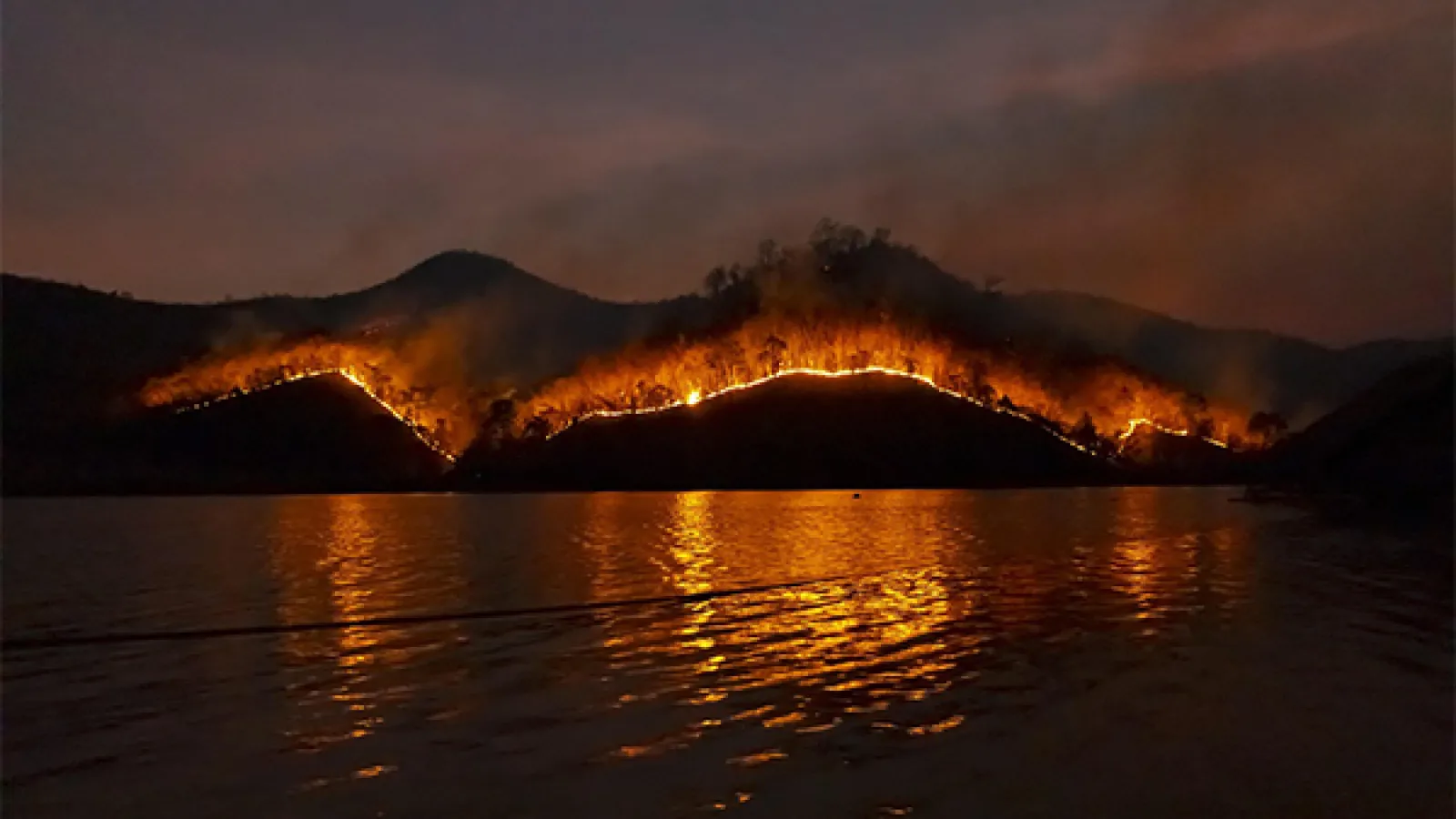
Wildfire statistics show their impact beyond burn damage

Wildfires leave behind devastation. In their wake, they destroy homes, businesses and wildlife. And according to research from assistant professor Kate Hu, their impact goes beyond just initial fires and burn zones.
Hu, who joined the Department of Statistics in 2024, initially became interested in studying wildfire statistics after completing her PhD. She worked for two climate tech companies, one focused on precision agriculture and the other on air monitoring. While serving as Head of Data Science at Aclima Inc, recognized as the most innovative company in data science by Fast Company in 2021, she worked on applying statistical methods to air monitoring using mobile vehicle-based sensing. In that work she saw firsthand how air quality and monitoring operations were affected, and often interrupted, by frequent wildfires that occur in late summer and fall.
Hu recently co-authored a paper titled, “Coexposure to extreme heat, wildfire burn zones, and wildfire smoke in the Western US from 2006 to 2020.” In it, she explored not only the effect of the fires themselves, but also its patterns with heat and wildfire smoke, and those who were impacted by these hazards.
“People living in poverty and the disabled are above the national average impacted by wildfires and wildfire smoke,” Hu said. “Possibly, because they lived in rural areas situated near the center of wildfire activity.”
In addition to the elderly, disabled and those with underlying health conditions having to deal with significant health concerns due to wildfires, the cost in damages makes it even more difficult for these low-income areas to recover. According to previous studies Hu’s research cited, the U.S. may lose approximately $100 billion annually from heat-induced lost labor productivity by 2050, and the economic burden of wildfires, including their health impacts, already tops at least $70 billion annually.

Typically, the reason for significant impact amongst the elderly and disabled is due to their lack of access to tools that could help them reduce the physical effects of wildfire exposure. Many also lack the awareness or resources to learn about these tools.
One example is an air quality monitor that can detect and alert people to poor conditions. The monitor that Hu’s research recommends cost between $100-$300.
“The communities that have a high poverty rate probably cannot afford it, or they don't think it's a problem,” she said. She hopes her research will help create awareness of the widespread impact of wildfire and wildfire smoke, the need for more localized air quality monitoring, and lay the groundwork for charitable organizations to consider purchasing low-cost air quality monitor devices as part of their client offerings. Individuals who can afford to purchase them can also share data online using today’s open data platforms to benefit the community.
Hu mentioned the 2023 wildfires in Canada as proof that even the East Coast and beyond can be affected. She was in Boston during the 2023 Canadian wildfires, where the air quality index, which is typically around 20 there, soared as high as 150. In Columbus, the smoke and haze were even worse, as parts of Ohio’s capital city hit a 154 on the air quality index. Once the AQI goes over 150, members of the public can start to experience health issues.
“On the East Coast, because they have more extreme heat days, there are cooling centers for those who cannot afford air conditioning,” Hu said. However, she added there are no equivalent facilities to help underprivileged people escape wildfire smoke, leaving high-risk groups in jeopardy.
Hu plans on continuing her research on this topic, particularly in the areas that are not typically discussed, such as those places on the East Coast or Midwest that experienced the consequences of the Canadian wildfires.
“Another direction of future research is to show the gaps of current EPA monitoring network to show where we should add more monitors from the perspective of wildfire smoke distribution,” she said. “Which can be very different from air pollution due to vehicles and industry pollution”
“We don't have a good understanding of wildfire and wildfire smoke impact,” Hu said, citing that car pollution and other emissions have to be taken into account as well when discussing air quality. “But we believe that in addition to the air pollutants such as CO impacts on health, these wildfires can also have mental health impacts as well because people cannot leave their homes.”
Ultimately, Hu hopes her research will open the eyes of citizens to the significance of widespread of wildfire smoke beyond the burn zones and encourage them to have a plan if and when wildfires, or their smoke, impact their lives.
“Extreme heat, wildfires and wildfire smoke can happen almost anywhere now,” Hu said. “Everyone should be alert to that.”