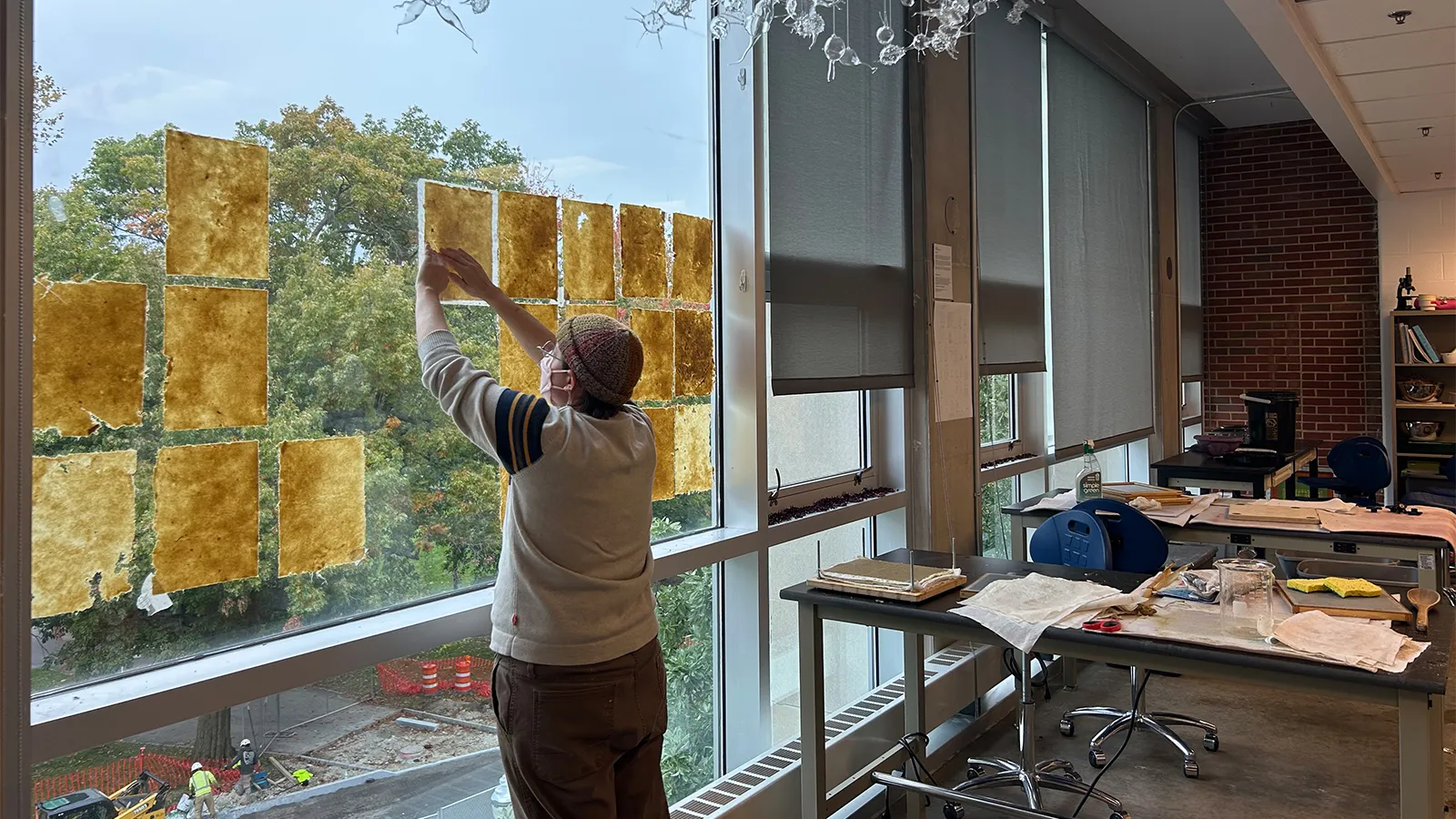
Arts and sciences find common ground in Living Art and Ecology Lab

Inside a lab space tucked away within Hopkins Hall, students and faculty in the College of Arts and Sciences are finding community among plants, paint and other projects focused on supporting the environment.
Founded in 2023, the Living Art and Ecology Lab is focused on creative research related to environmental causes and sustainability. Living art can refer to both ecological and biological arts, where artists work with natural materials or living organisms, and it can also refer to works that change over time.
Lab supervisor Emma Kline said the space encourages collaboration between the arts and sciences, all in support of the environment.
“There is a professor in the Department of Art, Laleh Mehran, who has joked before that every scientist's secret is that they wanted to be an artist,” Kline said. “I think there's some truth to that. I also think there's a bunch of artists who are really interested in the sciences.”
Kline has a background in both the arts and sciences. She holds a degree in ecology and evolutionary biology from Ohio State, worked as a field technician for the National Park Service, and has always been interested in ecological art and the use of natural dyes. She was brought in to help establish the lab and serve as a bridge between the disciplines, a combination that Kline said is more common than one might expect.
“We often see it as this dichotomy, but they're both fields that are based around observation of the natural world and curiosity for it and wanting to take part in it somehow, whether that's by asking scientific questions and generating data and trying to understand the world or responding to it in this more nonlinear or nonverbal way through the arts.”
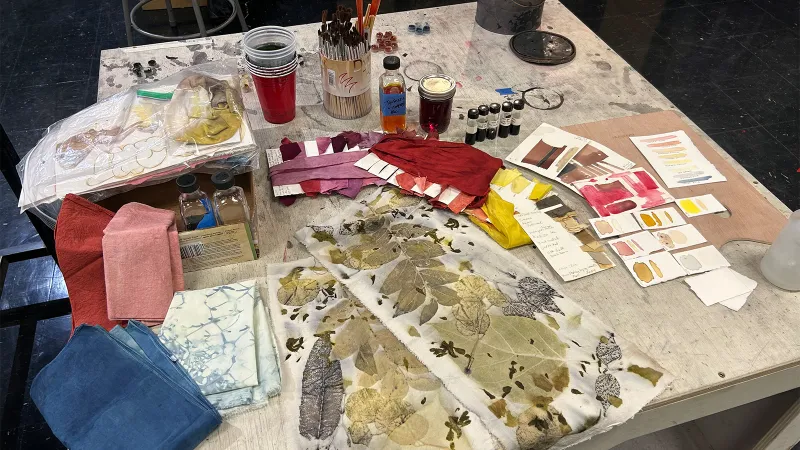
Projects from students, staff and faculty alike are present throughout the space, ranging from glass fixtures hanging from the ceiling to tubs filled with colorful dyes in the process of being turned into useable paint.
That paint-making is a common practice within the lab through the use of plant-based pigments — some from the lab’s own dye garden — that teach students the history behind the materials and how they move from nature to store shelves. In addition to learning about the materials, students also have the opportunity to connect and communicate with those from different disciplines.
“We have students from the arts and students from the sciences who are all interested in these shared subjects, but they're coming to them from different vocabularies, so to speak, and so what they quickly learn is that they have to find ways to communicate across those boundaries,” Kline said. “I think that's a skill that is really useful in any field that you're in, and so I hope that's something our students can take with them.”
The lab gives students not only a place to build connections with other students and faculty, but to pursue their interests outside of the classroom through hands-on learning activities.
“Within that, we do class workshops. We support grant-funded projects that are longer term or deeper dives into subject areas,” Kline said. “We do outreach events, both in the form of events that are open to the public or partnering with specific public entities.”
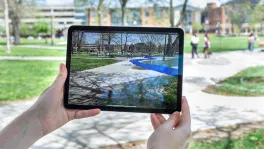
Two current examples of ecological visual art in the lab are Lost Waters and Lichen Likers. Lost Waters investigates the disappearance of Neil Run, a stream that used to run across the South Oval and Mirror Lake before it was removed to make way for land development. Now, with the help of a cross-disciplinary team that includes units from across Ohio State, Lost Waters’ AR and VR artwork shows how Ohio State’s landscape has changed.
Lichen Likers, meanwhile, is a group within the lab led by Professor Amy Youngs and Assistant Professor Doo-Sung Yoothat studies lichens – colorful organisms you can see on buildings, trees and gravestones – and uses them to inspire artwork and exhibitions.
“For Lost Waters and the Lichen Likers, we were able to hire 10 students through grant funding to have them do their own work within the project, so that was really rewarding,” Kline said. “Trying to create those research opportunities for students is one of the most important pieces of this for me.”