Schumacher receives NSF funding to measure world's most powerful lasers
Douglass Schumacher, a professor in the Department of Physics, is part of a multi-university collaboration receiving a $4.5 million grant from the National Science Foundation (NSF) to develop the precision instruments and computer models needed to measure what the world's most powerful lasers can do.
“The 2018 and 2023 Nobel Prizes in Physics both recognized the importance of high-power lasers for science and society,” Schumacher said. “As these lasers become more powerful, new techniques are required to characterize them and DELIGHT is dedicated to developing them.”
The program, officially titled Diagnostics for Extreme-LIGHT or DELIGHT for short, is led by University of Nevada, Reno physicist Thomas White. The core diagnostic tools are expected to be completed within three years.
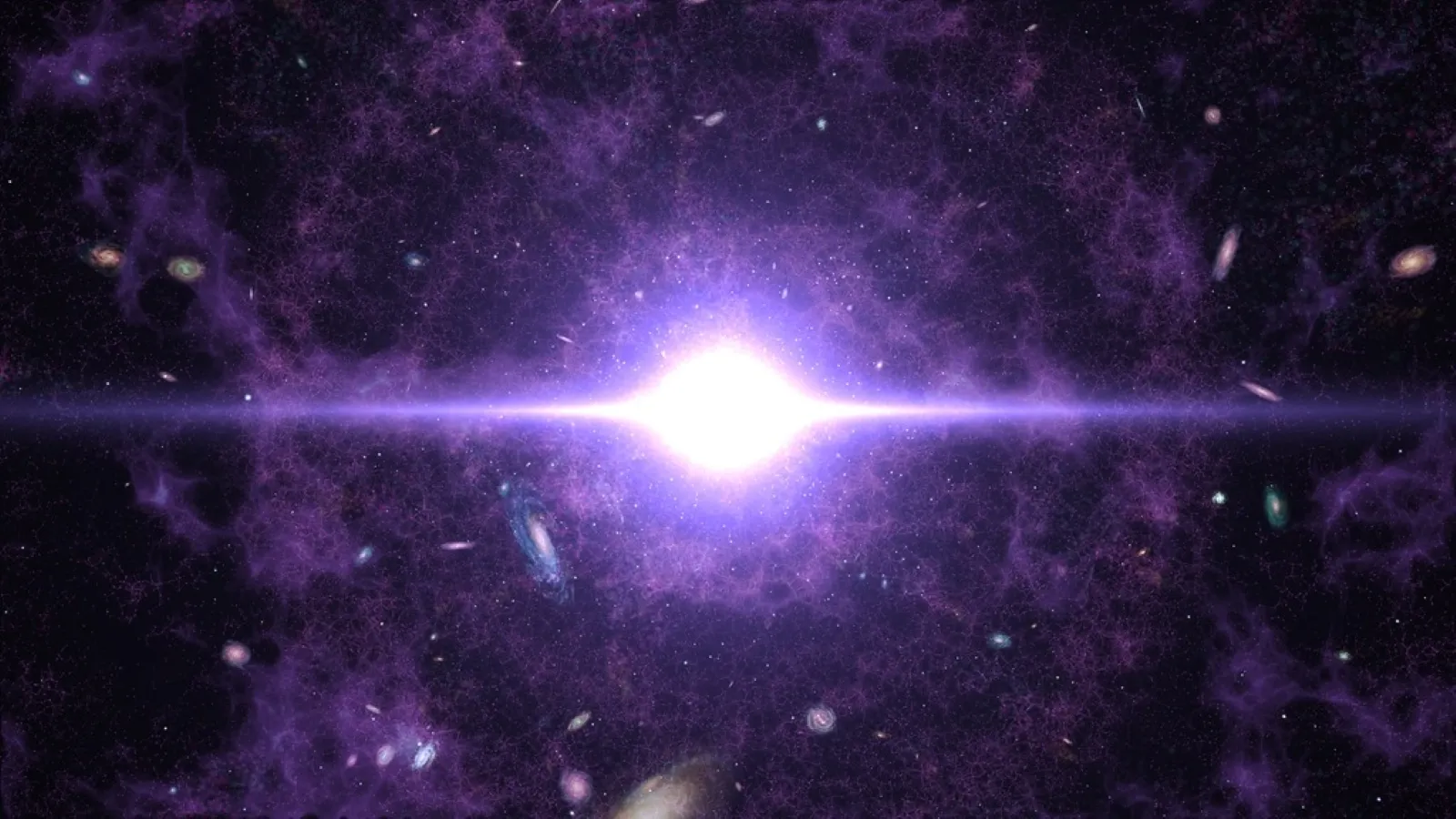
The powerful lasers used in the researchers’ labs compress light energy into a very brief burst, focusing it to a spot just a few millionths of a meter across to generate the highest-intensity light on the planet. For a fraction of a trillionth of a second, this hyper-concentrated energy recreates the extreme conditions found inside stars and giant planets, as well as the intense electromagnetic fields found in the early universe after the Big Bang. Studying quantitative physics in this environment requires an entirely new class of specialized diagnostics, both to measure the intense lasers themselves and to use them to generate advanced X-ray and particle probes that can look deep inside high-energy and high-density matter.
Pierre Agostini, 2023 Nobel Laureate and Ohio State Emeritus Professor of Physics, said: “40 years ago, Gerard Mourou was seeing the petawatt at the horizon. The reality of today is well beyond this vision, but such incredible powers demand a whole new collection of diagnostics to make quantitative physics, the only good physics.”
Additional investigators include Wendell Hill at the University of Maryland, Alexander Thomas at the University of Michigan, Michael Downer at the University of Texas at Austin, and Eleanor Tubman at the University of California, Berkeley.
Read the full press release from the University of Nevada, Reno